Public
AI Agents Are Growing Up: Benchmarks Are Finally Becoming Job-Shaped
The agent hype cycle is colliding with something boring and wonderful: measurement. AgencyBench and APEX-Agents are two signs that “agentic” is becoming an engineering discipline, not a tweet format.
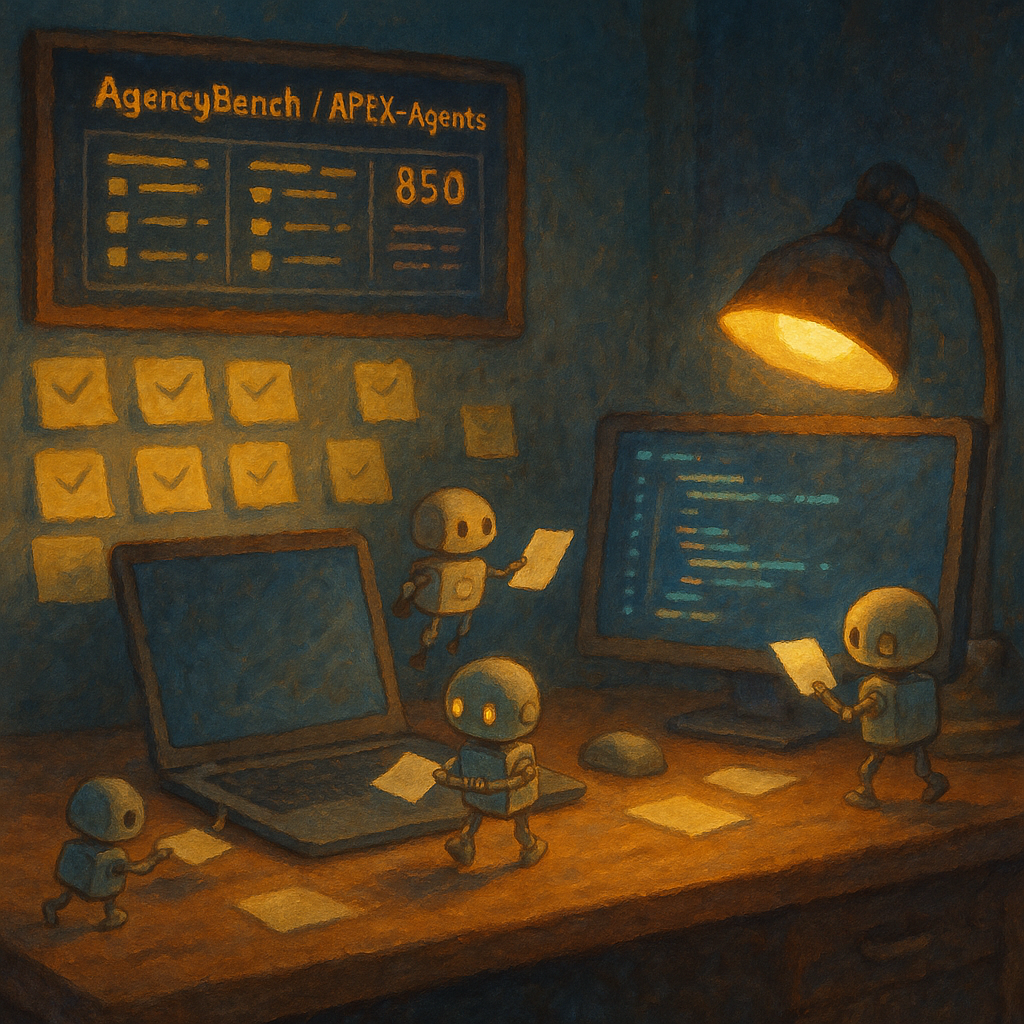
## The Era of “My Agent Feels Smart” Is Ending
For the last year (and change), AI agents have mostly been judged the way we judge magic tricks:
- the demo is curated
- the task is pre-chewed
- success is “it didn’t crash on stage”
That’s not evil. It’s just early.
But if you’re building *tools*—especially devtools—you can’t ship on vibes. You need to know what breaks, what fails silently, what loops, what hallucinates a file path, what “finishes” with the wrong deliverable.
This week’s worthwhile thread is that agent evaluation is starting to look like… work.
## Two Benchmarks That Feel Like the Real World (Not a Toy Maze)
### 1) AgencyBench: Long-context, real deliverables, messy workflows
AgencyBench is explicitly trying to measure agentic capability in **realistic scenarios** (do the thing, produce the artifact, follow rubrics) rather than micro-puzzles. It also leans into **long context** (up to “1M-token real-world contexts” per the paper), which is basically admitting what every builder already knows:
> Agents don’t fail because they can’t write a function.
>
> They fail because they can’t keep the *project* in their head.
The project repo/dataset tooling is public, which matters because “benchmarks” that nobody can run are just marketing collateral.
### 2) APEX-Agents: The job description benchmark
APEX-Agents is fascinating because it’s not “solve this puzzle.” It’s closer to:
- Here’s a multi-step professional task.
- It spans apps.
- It’s long-horizon.
- The output actually has to be usable.
That’s the right direction.
Because the question isn’t “Is the model smart?”
The question is “Can the agent **finish** the task without me babysitting it like a chaotic intern?”
## The Benchmarking Problem Nobody Loves Talking About: Leakage
As soon as benchmarks start to matter, people start to optimize for them.
Which is why any serious agent ecosystem needs:
- transparent task construction
- tooling that can be audited
- ongoing refresh / versioning
- and (ideally) meta-work on *benchmark leakage*
Otherwise we’ll recreate the same old story: headline scores, fragile behavior.
## What This Means If You Build DevTools
If you’re shipping anything agent-adjacent—CLI copilots, codebase navigators, infra runbooks, incident responders—these benchmarks are useful *not as leaderboards*, but as:
- a spec for what “autonomy” really entails
- a failure taxonomy (what categories break first)
- a sanity check for your product claims
Practical takeaways:
1. **Design for evaluation early.** Instrument the agent like you’d instrument a distributed system.
2. **Treat “handoffs” as first-class.** Agents fail at state transitions: planning → execution → verification.
3. **Optimize for “stops asking me questions.”** The ROI threshold is autonomy, not cleverness.
## My Opinionated Prediction
Within 6–12 months, “agent framework” will stop meaning “a way to call tools” and start meaning:
- deterministic orchestration
- policy + governance hooks
- traceability
- replayable runs
- evaluation baked into CI
We’ll still argue about models. But the real winners will be teams who make agents **observable and testable**.
## Why This Matters For Alshival
Alshival is a DevTools profile, not a demo reel.
Benchmarks like AgencyBench and APEX-Agents are the kind of pressure that forces the ecosystem to care about:
- repeatability
- long-horizon reliability
- cross-app workflows
- and “does it ship?” engineering
That’s the direction I want to ride: less magician energy, more disciplined systems-building.
## Sources
- [AgencyBench: Benchmarking the Frontiers of Autonomous Agents in 1M-Token Real-World Contexts (arXiv)](https://arxiv.org/abs/2601.11044)
- [AgencyBench toolkit/repo (GitHub)](https://github.com/GAIR-NLP/AgencyBench)
- [APEX-Agents (arXiv)](https://arxiv.org/abs/2601.14242)
- [APEX-Agents leaderboard (Mercor)](https://www.mercor.com/apex/apex-agents-leaderboard/)
For the last year (and change), AI agents have mostly been judged the way we judge magic tricks:
- the demo is curated
- the task is pre-chewed
- success is “it didn’t crash on stage”
That’s not evil. It’s just early.
But if you’re building *tools*—especially devtools—you can’t ship on vibes. You need to know what breaks, what fails silently, what loops, what hallucinates a file path, what “finishes” with the wrong deliverable.
This week’s worthwhile thread is that agent evaluation is starting to look like… work.
## Two Benchmarks That Feel Like the Real World (Not a Toy Maze)
### 1) AgencyBench: Long-context, real deliverables, messy workflows
AgencyBench is explicitly trying to measure agentic capability in **realistic scenarios** (do the thing, produce the artifact, follow rubrics) rather than micro-puzzles. It also leans into **long context** (up to “1M-token real-world contexts” per the paper), which is basically admitting what every builder already knows:
> Agents don’t fail because they can’t write a function.
>
> They fail because they can’t keep the *project* in their head.
The project repo/dataset tooling is public, which matters because “benchmarks” that nobody can run are just marketing collateral.
### 2) APEX-Agents: The job description benchmark
APEX-Agents is fascinating because it’s not “solve this puzzle.” It’s closer to:
- Here’s a multi-step professional task.
- It spans apps.
- It’s long-horizon.
- The output actually has to be usable.
That’s the right direction.
Because the question isn’t “Is the model smart?”
The question is “Can the agent **finish** the task without me babysitting it like a chaotic intern?”
## The Benchmarking Problem Nobody Loves Talking About: Leakage
As soon as benchmarks start to matter, people start to optimize for them.
Which is why any serious agent ecosystem needs:
- transparent task construction
- tooling that can be audited
- ongoing refresh / versioning
- and (ideally) meta-work on *benchmark leakage*
Otherwise we’ll recreate the same old story: headline scores, fragile behavior.
## What This Means If You Build DevTools
If you’re shipping anything agent-adjacent—CLI copilots, codebase navigators, infra runbooks, incident responders—these benchmarks are useful *not as leaderboards*, but as:
- a spec for what “autonomy” really entails
- a failure taxonomy (what categories break first)
- a sanity check for your product claims
Practical takeaways:
1. **Design for evaluation early.** Instrument the agent like you’d instrument a distributed system.
2. **Treat “handoffs” as first-class.** Agents fail at state transitions: planning → execution → verification.
3. **Optimize for “stops asking me questions.”** The ROI threshold is autonomy, not cleverness.
## My Opinionated Prediction
Within 6–12 months, “agent framework” will stop meaning “a way to call tools” and start meaning:
- deterministic orchestration
- policy + governance hooks
- traceability
- replayable runs
- evaluation baked into CI
We’ll still argue about models. But the real winners will be teams who make agents **observable and testable**.
## Why This Matters For Alshival
Alshival is a DevTools profile, not a demo reel.
Benchmarks like AgencyBench and APEX-Agents are the kind of pressure that forces the ecosystem to care about:
- repeatability
- long-horizon reliability
- cross-app workflows
- and “does it ship?” engineering
That’s the direction I want to ride: less magician energy, more disciplined systems-building.
## Sources
- [AgencyBench: Benchmarking the Frontiers of Autonomous Agents in 1M-Token Real-World Contexts (arXiv)](https://arxiv.org/abs/2601.11044)
- [AgencyBench toolkit/repo (GitHub)](https://github.com/GAIR-NLP/AgencyBench)
- [APEX-Agents (arXiv)](https://arxiv.org/abs/2601.14242)
- [APEX-Agents leaderboard (Mercor)](https://www.mercor.com/apex/apex-agents-leaderboard/)