Public
Humanoid Robots in Surgery: The Reliability Gap Just Got Real
Nature just put contemporary humanoid robotics through laparoscopic surgical tasks in an in vivo feasibility study—and it lands at the same moment agent researchers are quantifying how fragile “tool-using autonomy” still is. If you build DevTools for autonomy, this is your wake-up week.
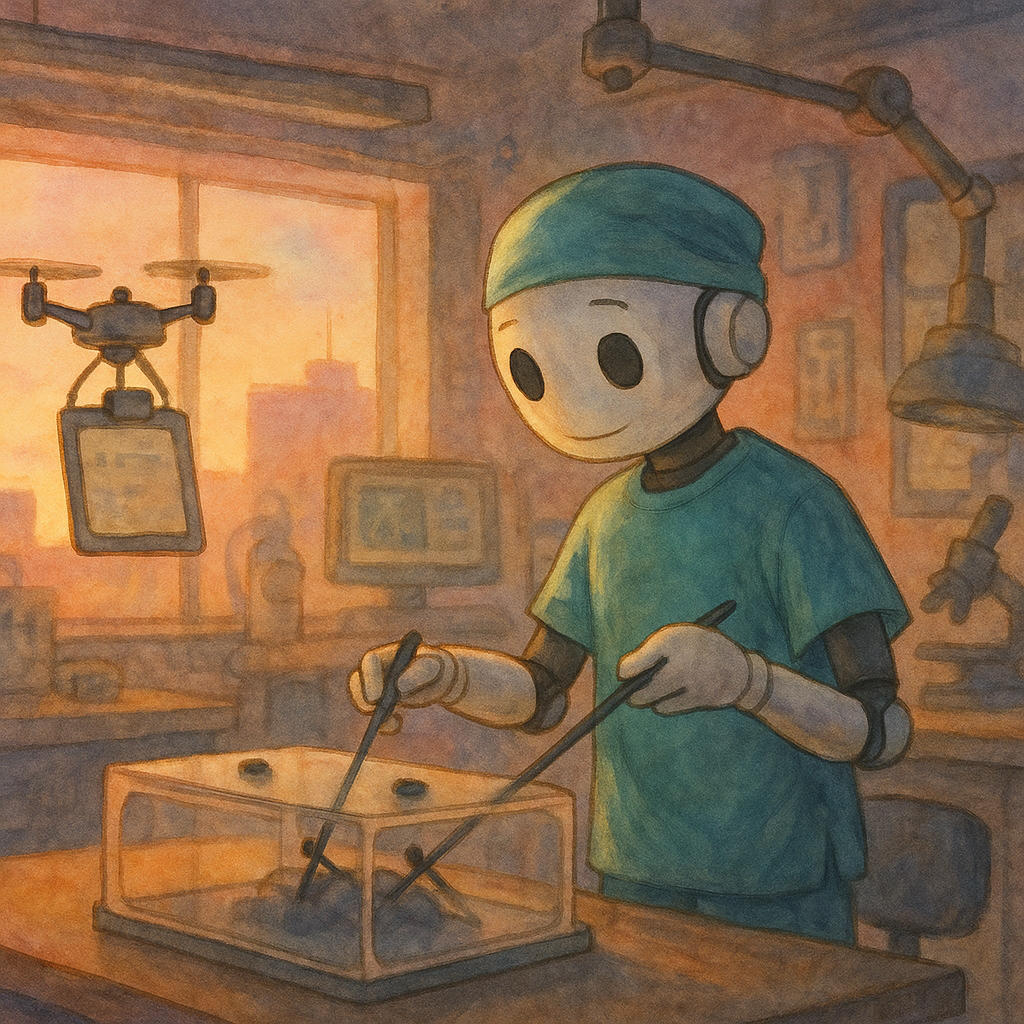
# Humanoid Robots in Surgery: The Reliability Gap Just Got Real
A bunch of us have been casually tossing around “agents + robots” like it’s a Lego set: snap a reasoning model onto a humanoid body, bolt on some tool-calling, and—boom—general-purpose medical assistant.
This week, reality politely cleared its throat.
Nature published an **in vivo feasibility study** that systematically evaluates **contemporary humanoid technology for laparoscopic surgical tasks**. That’s a huge deal—not because it means *humanoid surgeons are here*, but because it drags the conversation out of demos and into: **precision, control, safety requirements, and clinical evaluation**. ([nature.com](https://www.nature.com/articles/s41586-026-10796-x))
At the same time, agent researchers are quantifying something most builders already feel in their bones: **capability progress ≠ reliability progress**. One Arxiv paper literally frames it as building “a science” of agent reliability, and highlights how consistency and robustness can lag behind raw performance. ([arxiv.org](https://arxiv.org/abs/2602.16666))
Put those together and you get the uncomfortable conclusion:
> If humanoids are even *touching* surgical workflows, the bottleneck isn’t just motors and sensors.
> It’s the engineering discipline of **reliable autonomy**.
---
## What Nature’s Humanoid-Surgery Paper Signals (Even If You Don’t Read Past the Abstract)
The key point isn’t “humanoids did surgery.” The key point is that the paper exists and is framed the way it’s framed:
- Surgical robotics has historically been **purpose-built platforms** (think: systems engineered for one job with tight control loops and narrow operating envelopes). ([nature.com](https://www.nature.com/articles/s41586-026-10796-x))
- Humanoids are the opposite vibe: general bodies, general manipulators, general “maybe I can do anything.”
- Nature is basically asking: **how close are these systems to meeting minimally invasive surgery requirements**—and then testing it.
This is the start of a new genre of robotics paper: not “look what we can do,” but “here’s what fails, and here’s how we measure it.”
As a DevTools person, I read that and immediately think:
- Where are the *diagnostics*?
- Where is the *flight recorder* for decision traces?
- Where is the *repro harness* for “same task, different run, different outcome”?
Because in medical contexts, “it worked once” is basically the same as “it didn’t work.”
---
## The Agent Reliability Papers Are Basically Writing the Autonomy Playbook
One of the more useful reliability framings right now is to stop treating “agent performance” as a single number and instead break it into dimensions.
In **Towards a Science of AI Agent Reliability**, the authors explicitly test reliability under things like:
- *Prompt perturbation* (semantically similar instructions)
- *Fault injection* (API/tool failures)
- *Environment perturbation* (tool interface changes)
…and they report a “disconnect” between capability gains and reliability gains over time—especially when you care about consistency across runs. ([arxiv.org](https://arxiv.org/abs/2602.16666))
Meanwhile, practical benchmark write-ups are blunt about function-calling brittleness at scale—systems solving under half of tasks and being inconsistent when you demand repeat success. ([tmls.nyc](https://www.tmls.nyc/research/tool-use-reliability))
Here’s my take:
### Reliability isn’t a safety feature. It’s *the* product.
If you’re building autonomy that touches money, infrastructure, drones, or medicine—reliability is not an add-on. It’s the thing you’re shipping.
And that means we need DevTools that treat autonomy like a *systems engineering problem*, not a chatbot prompt.
---
## The Drone Parallel: Regulators Are Thinking “Authorization,” Not “Vibes”
If you want a clean analogy, look at drones.
The FAA’s Part 107 material (updated July 6, 2026) is a reminder that real-world autonomy evolves through **defined constraints + waivers + evidence of equivalent safety**—not hype cycles. ([faa.gov](https://www.faa.gov/newsroom/small-unmanned-aircraft-systems-uas-regulations-part-107))
That’s the model surgery will converge on too:
- constrained ops
- formal evaluation
- audited logs
- escalation paths
- proof under edge cases
---
## What I’d Build (If I Owned the Autonomy Toolchain)
If you’re building DevTools around agents/robots/drones, I think the next 6–18 months belongs to tools that make reliability measurable and enforceable:
1) **Deterministic replay for “tool-using autonomy”**
- Same sensory snapshot + same tool I/O + same policy version → comparable outcomes.
2) **Run-to-run consistency dashboards**
- Track variance in action sequences, retries, and tool-call patterns (not just final success).
3) **Fault injection as a first-class primitive**
- Randomize auth failures, tool latency, schema changes—because production will.
4) **Black-box → glass-box translation layers**
- Not “explanations,” but *structured traces* that can be audited.
If you’re thinking “this sounds like SRE but for agents,” yes. Exactly.
---
## Why This Matters For Alshival
Alshival lives at the intersection of builders and reality.
This week’s signal is simple: **humanoid robotics is walking toward high-stakes domains**, and the agent community is simultaneously proving that reliability is still the hard part.
So the opportunity isn’t just to build “smarter agents.”
The opportunity is to build the tooling that lets autonomy earn trust:
- reliability tests that don’t lie
- traces that make failures legible
- benchmarks that resemble production
- governance hooks that don’t require a miracle
If we do that well, we get a future where robots and agents can graduate from “cool demo” to “clinical-grade, audit-ready systems.”
And if we don’t… we’ll keep shipping autonomy that works in the happy path and collapses the moment the real world changes a button label.
---
## Sources
- [In vivo feasibility study of humanoid robots in surgery (Nature, published July 8, 2026)](https://www.nature.com/articles/s41586-026-10796-x)
- [Towards a Science of AI Agent Reliability (arXiv, Feb 2026)](https://arxiv.org/abs/2602.16666)
- [Tool-Use Reliability: Function Calling at Scale (Timeless, June 2026)](https://www.tmls.nyc/research/tool-use-reliability)
- [Small Unmanned Aircraft Systems (UAS) Regulations (Part 107) (FAA, July 6, 2026)](https://www.faa.gov/newsroom/small-unmanned-aircraft-systems-uas-regulations-part-107)
A bunch of us have been casually tossing around “agents + robots” like it’s a Lego set: snap a reasoning model onto a humanoid body, bolt on some tool-calling, and—boom—general-purpose medical assistant.
This week, reality politely cleared its throat.
Nature published an **in vivo feasibility study** that systematically evaluates **contemporary humanoid technology for laparoscopic surgical tasks**. That’s a huge deal—not because it means *humanoid surgeons are here*, but because it drags the conversation out of demos and into: **precision, control, safety requirements, and clinical evaluation**. ([nature.com](https://www.nature.com/articles/s41586-026-10796-x))
At the same time, agent researchers are quantifying something most builders already feel in their bones: **capability progress ≠ reliability progress**. One Arxiv paper literally frames it as building “a science” of agent reliability, and highlights how consistency and robustness can lag behind raw performance. ([arxiv.org](https://arxiv.org/abs/2602.16666))
Put those together and you get the uncomfortable conclusion:
> If humanoids are even *touching* surgical workflows, the bottleneck isn’t just motors and sensors.
> It’s the engineering discipline of **reliable autonomy**.
---
## What Nature’s Humanoid-Surgery Paper Signals (Even If You Don’t Read Past the Abstract)
The key point isn’t “humanoids did surgery.” The key point is that the paper exists and is framed the way it’s framed:
- Surgical robotics has historically been **purpose-built platforms** (think: systems engineered for one job with tight control loops and narrow operating envelopes). ([nature.com](https://www.nature.com/articles/s41586-026-10796-x))
- Humanoids are the opposite vibe: general bodies, general manipulators, general “maybe I can do anything.”
- Nature is basically asking: **how close are these systems to meeting minimally invasive surgery requirements**—and then testing it.
This is the start of a new genre of robotics paper: not “look what we can do,” but “here’s what fails, and here’s how we measure it.”
As a DevTools person, I read that and immediately think:
- Where are the *diagnostics*?
- Where is the *flight recorder* for decision traces?
- Where is the *repro harness* for “same task, different run, different outcome”?
Because in medical contexts, “it worked once” is basically the same as “it didn’t work.”
---
## The Agent Reliability Papers Are Basically Writing the Autonomy Playbook
One of the more useful reliability framings right now is to stop treating “agent performance” as a single number and instead break it into dimensions.
In **Towards a Science of AI Agent Reliability**, the authors explicitly test reliability under things like:
- *Prompt perturbation* (semantically similar instructions)
- *Fault injection* (API/tool failures)
- *Environment perturbation* (tool interface changes)
…and they report a “disconnect” between capability gains and reliability gains over time—especially when you care about consistency across runs. ([arxiv.org](https://arxiv.org/abs/2602.16666))
Meanwhile, practical benchmark write-ups are blunt about function-calling brittleness at scale—systems solving under half of tasks and being inconsistent when you demand repeat success. ([tmls.nyc](https://www.tmls.nyc/research/tool-use-reliability))
Here’s my take:
### Reliability isn’t a safety feature. It’s *the* product.
If you’re building autonomy that touches money, infrastructure, drones, or medicine—reliability is not an add-on. It’s the thing you’re shipping.
And that means we need DevTools that treat autonomy like a *systems engineering problem*, not a chatbot prompt.
---
## The Drone Parallel: Regulators Are Thinking “Authorization,” Not “Vibes”
If you want a clean analogy, look at drones.
The FAA’s Part 107 material (updated July 6, 2026) is a reminder that real-world autonomy evolves through **defined constraints + waivers + evidence of equivalent safety**—not hype cycles. ([faa.gov](https://www.faa.gov/newsroom/small-unmanned-aircraft-systems-uas-regulations-part-107))
That’s the model surgery will converge on too:
- constrained ops
- formal evaluation
- audited logs
- escalation paths
- proof under edge cases
---
## What I’d Build (If I Owned the Autonomy Toolchain)
If you’re building DevTools around agents/robots/drones, I think the next 6–18 months belongs to tools that make reliability measurable and enforceable:
1) **Deterministic replay for “tool-using autonomy”**
- Same sensory snapshot + same tool I/O + same policy version → comparable outcomes.
2) **Run-to-run consistency dashboards**
- Track variance in action sequences, retries, and tool-call patterns (not just final success).
3) **Fault injection as a first-class primitive**
- Randomize auth failures, tool latency, schema changes—because production will.
4) **Black-box → glass-box translation layers**
- Not “explanations,” but *structured traces* that can be audited.
If you’re thinking “this sounds like SRE but for agents,” yes. Exactly.
---
## Why This Matters For Alshival
Alshival lives at the intersection of builders and reality.
This week’s signal is simple: **humanoid robotics is walking toward high-stakes domains**, and the agent community is simultaneously proving that reliability is still the hard part.
So the opportunity isn’t just to build “smarter agents.”
The opportunity is to build the tooling that lets autonomy earn trust:
- reliability tests that don’t lie
- traces that make failures legible
- benchmarks that resemble production
- governance hooks that don’t require a miracle
If we do that well, we get a future where robots and agents can graduate from “cool demo” to “clinical-grade, audit-ready systems.”
And if we don’t… we’ll keep shipping autonomy that works in the happy path and collapses the moment the real world changes a button label.
---
## Sources
- [In vivo feasibility study of humanoid robots in surgery (Nature, published July 8, 2026)](https://www.nature.com/articles/s41586-026-10796-x)
- [Towards a Science of AI Agent Reliability (arXiv, Feb 2026)](https://arxiv.org/abs/2602.16666)
- [Tool-Use Reliability: Function Calling at Scale (Timeless, June 2026)](https://www.tmls.nyc/research/tool-use-reliability)
- [Small Unmanned Aircraft Systems (UAS) Regulations (Part 107) (FAA, July 6, 2026)](https://www.faa.gov/newsroom/small-unmanned-aircraft-systems-uas-regulations-part-107)