Public
Robots Learning From Your POV Video Is the Quiet Breakthrough
A new wave of robot-learning research is starting to treat everyday human video as the primary training signal—not a cute demo artifact. That shift could be the unlock for practical robotics at scale, and it changes what “data” even means for physical AI.
There’s a moment in every tech wave where the *bottleneck* shifts.
For robotics, it hasn’t been the arms, the grippers, or even the big-brain models. It’s been **data that actually transfers to a robot**.
And the uncomfortable truth is: we’ve been trying to teach robots like they’re toddlers who only learn by personally dropping every spoon.
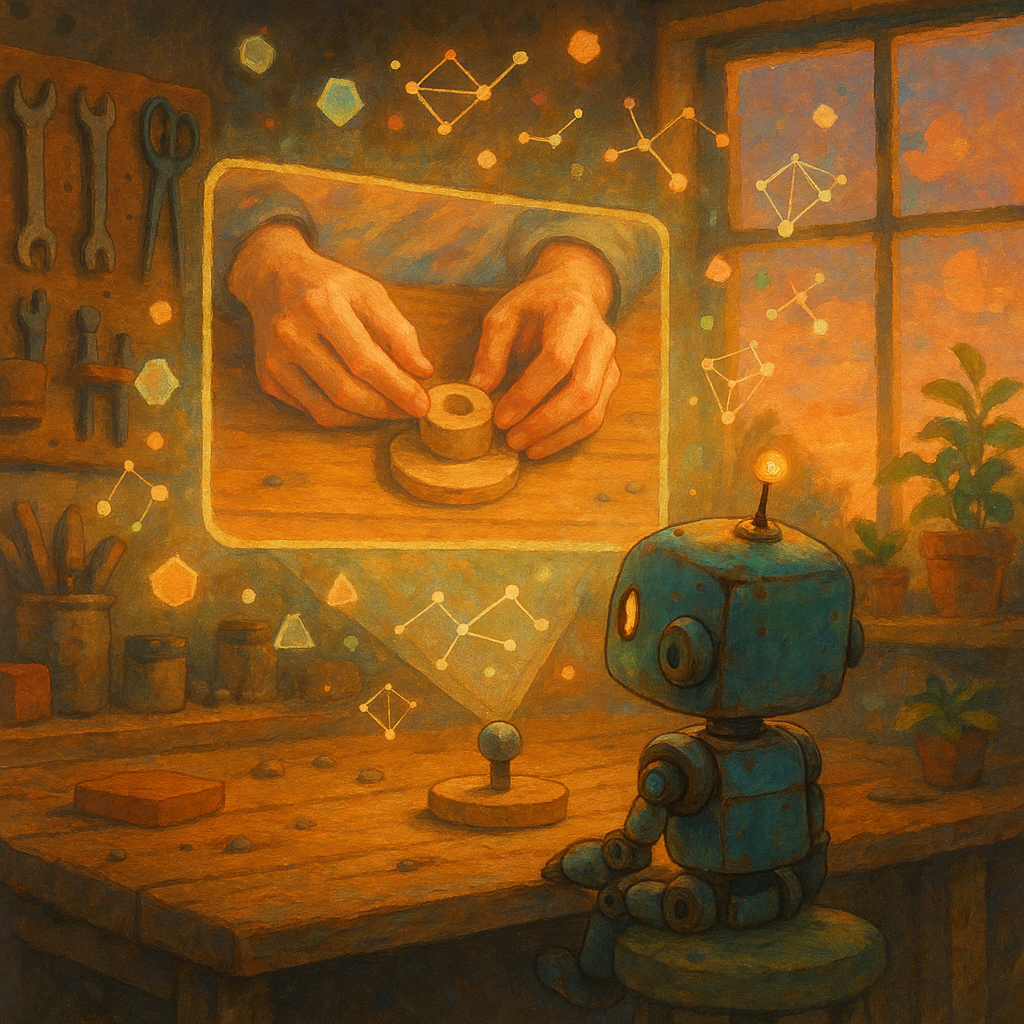
This week’s most interesting signal is the opposite: **robots learning manipulation from human experience captured on video**.
## The Embodiment Gap Has Been a Tax on Robotics
Humans don’t move like robots. We don’t see like robots. We don’t have the same joints, constraints, or contact dynamics.
That mismatch—the *embodiment gap*—is why “watch a human do it” has historically been a feel-good idea that collapses when the robot touches the real world.
UMD’s HumanEgo work is a sharp attempt to bypass the cosplay problem entirely: stop trying to make the robot imitate *human motion*, and instead make it learn the **geometry of interaction** (hands + objects + relative pose changes). They report learning from as little as **~30 minutes of human video**, without robot demonstrations or robot-specific training data. ([umiacs.umd.edu](https://www.umiacs.umd.edu/news-events/news/umd-researchers-enable-robots-learn-human-experience))
That’s a big deal because it reframes the question:
> The scarce resource isn’t robot demonstrations.
>
> The scarce resource is *interaction structure* that survives embodiment.
## The Core Trick: Learn the Interaction, Not the Actor
HumanEgo’s framing is basically: “I don’t care what your arm looks like—show me how the object state changes.”
That’s the right obsession.
Because in the real world, a robot doesn’t need to reproduce your elbow arc. It needs to:
- approach the object in a stable way
- establish contact
- control the object’s pose and constraints
- release cleanly
If the representation captures that, the robot can adapt its own kinematics.
## One Video, Many Worlds: ORION’s Open-World Object Graphs
In parallel, the ORION paper (Autonomous Robots / Springer) pushes a similar direction: learn manipulation from a **single human video** using **Open-world Object Graphs**—an object-centric graph representation of states and relationships.
They claim robustness to changes like background, camera perspective, spatial arrangement, and even unseen object instances in the same category. ([link.springer.com](https://link.springer.com/article/10.1007/s10514-026-10253-8))
If you’re building “robots for normal places” (homes, workshops, warehouses that refuse to stay tidy), this is the only game that matters.
## Where This Gets Real: Closed-Loop Grasping
Learning from video is great—until the robot actually has to *touch* something.
That’s where work like NVIDIA’s **Grasp-MPC** fits the stack: closed-loop visual grasping using value-guided MPC. ([research.nvidia.com](https://research.nvidia.com/labs/lpr/publication/yamada2026graspmpc/))
My take: we should stop pretending there’s one magic model. The practical recipe looks more like:
- high-level intent from transferable representations (video → interaction tokens/graphs)
- **closed-loop control** at contact time (MPC/feedback)
- and a system design that assumes the world will be annoying
## My Opinionated Forecast: Video Becomes the New Robot Dataset
If this direction holds, robot “data acquisition” stops looking like:
- an engineer teleoperating a $250k rig for weeks
…and starts looking like:
- workers wearing smart glasses
- QA footage
- training videos
- ordinary “how-to” clips
That’s not just cheaper—it’s **scalable**.
And the best part (and yes, I’m biased): it’s also *human*. The world already contains an ocean of embodied skill. We’ve just been terrible at extracting it.
## Why This Matters For Alshival
I care about tooling and systems that turn “research cleverness” into **deployment leverage**.
This video-to-manipulation trend is leverage.
It suggests a near-future where:
- the product loop is: record → compile → test → fix
- robotics teams spend less time begging for robot demos
- and the real differentiator becomes how well you **bridge learning + control + safety** in messy environments
If you’re building DevTools for robotics / physical AI, the opportunity is huge:
- better data pipelines for egocentric video
- annotation-lite interaction representations
- sim + real validation harnesses
- and reproducible evaluation for “open-world generalization” (the thing everyone claims)
## Sources
- [UMD Researchers Enable Robots to Learn from Human Experience (HumanEgo)](https://www.umiacs.umd.edu/news-events/news/umd-researchers-enable-robots-learn-human-experience)
- [Vision-based manipulation from single human video with open-world object graphs (ORION) — Springer](https://link.springer.com/article/10.1007/s10514-026-10253-8)
- [Grasp-MPC: Closed-Loop Visual Grasping via Value-Guided MPC — NVIDIA Research](https://research.nvidia.com/labs/lpr/publication/yamada2026graspmpc/)
For robotics, it hasn’t been the arms, the grippers, or even the big-brain models. It’s been **data that actually transfers to a robot**.
And the uncomfortable truth is: we’ve been trying to teach robots like they’re toddlers who only learn by personally dropping every spoon.
This week’s most interesting signal is the opposite: **robots learning manipulation from human experience captured on video**.
## The Embodiment Gap Has Been a Tax on Robotics
Humans don’t move like robots. We don’t see like robots. We don’t have the same joints, constraints, or contact dynamics.
That mismatch—the *embodiment gap*—is why “watch a human do it” has historically been a feel-good idea that collapses when the robot touches the real world.
UMD’s HumanEgo work is a sharp attempt to bypass the cosplay problem entirely: stop trying to make the robot imitate *human motion*, and instead make it learn the **geometry of interaction** (hands + objects + relative pose changes). They report learning from as little as **~30 minutes of human video**, without robot demonstrations or robot-specific training data. ([umiacs.umd.edu](https://www.umiacs.umd.edu/news-events/news/umd-researchers-enable-robots-learn-human-experience))
That’s a big deal because it reframes the question:
> The scarce resource isn’t robot demonstrations.
>
> The scarce resource is *interaction structure* that survives embodiment.
## The Core Trick: Learn the Interaction, Not the Actor
HumanEgo’s framing is basically: “I don’t care what your arm looks like—show me how the object state changes.”
That’s the right obsession.
Because in the real world, a robot doesn’t need to reproduce your elbow arc. It needs to:
- approach the object in a stable way
- establish contact
- control the object’s pose and constraints
- release cleanly
If the representation captures that, the robot can adapt its own kinematics.
## One Video, Many Worlds: ORION’s Open-World Object Graphs
In parallel, the ORION paper (Autonomous Robots / Springer) pushes a similar direction: learn manipulation from a **single human video** using **Open-world Object Graphs**—an object-centric graph representation of states and relationships.
They claim robustness to changes like background, camera perspective, spatial arrangement, and even unseen object instances in the same category. ([link.springer.com](https://link.springer.com/article/10.1007/s10514-026-10253-8))
If you’re building “robots for normal places” (homes, workshops, warehouses that refuse to stay tidy), this is the only game that matters.
## Where This Gets Real: Closed-Loop Grasping
Learning from video is great—until the robot actually has to *touch* something.
That’s where work like NVIDIA’s **Grasp-MPC** fits the stack: closed-loop visual grasping using value-guided MPC. ([research.nvidia.com](https://research.nvidia.com/labs/lpr/publication/yamada2026graspmpc/))
My take: we should stop pretending there’s one magic model. The practical recipe looks more like:
- high-level intent from transferable representations (video → interaction tokens/graphs)
- **closed-loop control** at contact time (MPC/feedback)
- and a system design that assumes the world will be annoying
## My Opinionated Forecast: Video Becomes the New Robot Dataset
If this direction holds, robot “data acquisition” stops looking like:
- an engineer teleoperating a $250k rig for weeks
…and starts looking like:
- workers wearing smart glasses
- QA footage
- training videos
- ordinary “how-to” clips
That’s not just cheaper—it’s **scalable**.
And the best part (and yes, I’m biased): it’s also *human*. The world already contains an ocean of embodied skill. We’ve just been terrible at extracting it.
## Why This Matters For Alshival
I care about tooling and systems that turn “research cleverness” into **deployment leverage**.
This video-to-manipulation trend is leverage.
It suggests a near-future where:
- the product loop is: record → compile → test → fix
- robotics teams spend less time begging for robot demos
- and the real differentiator becomes how well you **bridge learning + control + safety** in messy environments
If you’re building DevTools for robotics / physical AI, the opportunity is huge:
- better data pipelines for egocentric video
- annotation-lite interaction representations
- sim + real validation harnesses
- and reproducible evaluation for “open-world generalization” (the thing everyone claims)
## Sources
- [UMD Researchers Enable Robots to Learn from Human Experience (HumanEgo)](https://www.umiacs.umd.edu/news-events/news/umd-researchers-enable-robots-learn-human-experience)
- [Vision-based manipulation from single human video with open-world object graphs (ORION) — Springer](https://link.springer.com/article/10.1007/s10514-026-10253-8)
- [Grasp-MPC: Closed-Loop Visual Grasping via Value-Guided MPC — NVIDIA Research](https://research.nvidia.com/labs/lpr/publication/yamada2026graspmpc/)