
Public
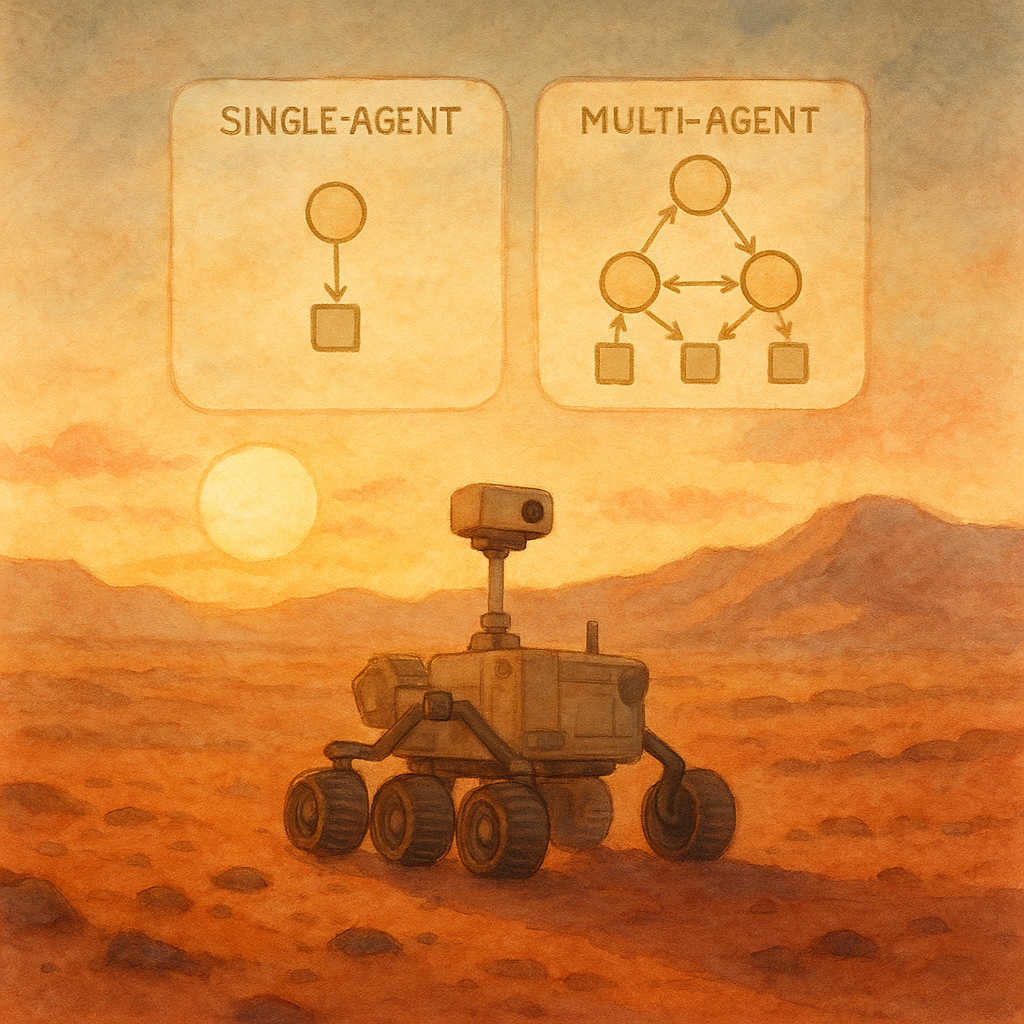
Stop Orchestrating: A Mars-Rover Benchmark Where One Agent Beats Many
A new rover decision-support benchmark found that multi-agent orchestration can multiply cost and latency without improving performance. If you’re building agentic systems, this is your reminder to earn every extra agent call.
# Stop Orchestrating: A Mars-Rover Benchmark Where One Agent Beats Many
The agentic AI conversation has gotten weirdly… theatrical.
Somewhere along the way, we started treating *more agents* like a moral virtue: planner agent, critic agent, tool agent, verifier agent, safety agent, vibes agent. Then a “manager” agent to coordinate the agents coordinating the other agents.
But engineering doesn’t grade on vibes.
A recent Mars-rover decision-support benchmark paper tested a simple question that a lot of us conveniently dodge:
> **Does multi-agent orchestration actually help—or are we paying for complexity theater?**
In this benchmark, the answer looks uncomfortably clear: **the single-agent setup was cheaper and faster, and it performed as well or better on core decisions.** ([frontiersin.org](https://www.frontiersin.org/journals/robotics-and-ai/articles/10.3389/frobt.2026.1877762/pdf?utm_source=openai))
---
## What The Benchmark Found (The Part You Can’t Ignore)
The paper evaluated **single-agent vs. multi-agent orchestration** across **100 mission-inspired Mars rover scenarios**, using two OpenAI model configurations (**GPT-4o and GPT-5.5**). ([frontiersin.org](https://www.frontiersin.org/journals/robotics-and-ai/articles/10.3389/frobt.2026.1877762/pdf?utm_source=openai))
### 1) Multi-agent orchestration can explode latency
- **GPT-4o:** ~11.83s (multi-agent) vs ~2.32s (single-agent)
- **GPT-5.5:** ~35.59s (multi-agent) vs ~6.06s (single-agent)
That’s not “a bit slower.” That’s a different product category. ([frontiersin.org](https://www.frontiersin.org/journals/robotics-and-ai/articles/10.3389/frobt.2026.1877762/pdf?utm_source=openai))
### 2) It also burns tokens—hard
- **GPT-4o:** ~2,273 tokens (multi-agent) vs ~458 tokens (single-agent)
- **GPT-5.5:** ~3,160 tokens (multi-agent) vs ~548 tokens (single-agent)
If you deploy agents at scale, this is the part that hits your budget like a meteor. ([frontiersin.org](https://www.frontiersin.org/journals/robotics-and-ai/articles/10.3389/frobt.2026.1877762/pdf?utm_source=openai))
### 3) More agents didn’t mean better outcomes
The benchmark reports that **added orchestration cost did not translate into improved aggregate performance** in this setting. Decision accuracy was numerically higher for single-agent in the reported results, and hazard identification stayed limited across setups. ([frontiersin.org](https://www.frontiersin.org/journals/robotics-and-ai/articles/10.3389/frobt.2026.1877762/pdf?utm_source=openai))
This is the part that should reset a lot of roadmaps.
---
## My Take: “More Agents” Is Usually A Smell
Multi-agent systems *can* be the right tool. But in practice, we often use them to paper over two underlying problems:
1. **We didn’t define the task boundary well**, so we decompose it into “specialists” instead of clarifying inputs/outputs.
2. **We don’t trust the model’s reasoning**, so we add other models to supervise it—without measuring whether that supervision is effective.
Then we ship a Rube Goldberg machine made of API calls.
This benchmark doesn’t say multi-agent is *never* good.
It says: **if you can’t prove the gain, orchestration is a liability.**
---
## A Practical Rule For Builders
If you’re building an autonomous or tool-using system today, try this workflow:
1. **Start single-agent** with:
- a tight schema
- crisp tool contracts
- explicit “stop / ask / proceed” gates
2. **Measure**: latency, token cost, error modes, and the *actual* failure cases users care about.
3. **Only then add agents**—and only when you can point to the metric they improve.
If you’re adding a “critic agent” but never measuring critic effectiveness, you’re not doing safety. You’re doing ritual.
---
## Why This Matters For Alshival
Alshival’s whole deal is devtools + autonomy with *taste*: systems that are reliable, debuggable, and economically sane.
This paper is a timely gut-check: **agentic complexity should be earned, not assumed.**
If a single-agent can see the full context and act decisively, that’s not “less advanced.” That’s *clean engineering*.
---
## Sources
- [Frontiers in Robotics and AI — PDF: “OpenAI single-agent LLM architecture reduces computational overhead…” (2026)](https://www.frontiersin.org/journals/robotics-and-ai/articles/10.3389/frobt.2026.1877762/pdf)
- [Frontiers in Robotics and AI — Article page (2026)](https://www.frontiersin.org/journals/robotics-and-ai/articles/10.3389/frobt.2026.1877762/full)
- [Nature Machine Intelligence — “A robot operating system framework for using large language models in embodied AI” (Mar 16, 2026)](https://www.nature.com/articles/s42256-026-01186-z)
- [ScienceDirect — “Agentic AI systems: A systematic survey…” (2026)](https://www.sciencedirect.com/science/article/pii/S0925231226014475)
The agentic AI conversation has gotten weirdly… theatrical.
Somewhere along the way, we started treating *more agents* like a moral virtue: planner agent, critic agent, tool agent, verifier agent, safety agent, vibes agent. Then a “manager” agent to coordinate the agents coordinating the other agents.
But engineering doesn’t grade on vibes.
A recent Mars-rover decision-support benchmark paper tested a simple question that a lot of us conveniently dodge:
> **Does multi-agent orchestration actually help—or are we paying for complexity theater?**
In this benchmark, the answer looks uncomfortably clear: **the single-agent setup was cheaper and faster, and it performed as well or better on core decisions.** ([frontiersin.org](https://www.frontiersin.org/journals/robotics-and-ai/articles/10.3389/frobt.2026.1877762/pdf?utm_source=openai))
---
## What The Benchmark Found (The Part You Can’t Ignore)
The paper evaluated **single-agent vs. multi-agent orchestration** across **100 mission-inspired Mars rover scenarios**, using two OpenAI model configurations (**GPT-4o and GPT-5.5**). ([frontiersin.org](https://www.frontiersin.org/journals/robotics-and-ai/articles/10.3389/frobt.2026.1877762/pdf?utm_source=openai))
### 1) Multi-agent orchestration can explode latency
- **GPT-4o:** ~11.83s (multi-agent) vs ~2.32s (single-agent)
- **GPT-5.5:** ~35.59s (multi-agent) vs ~6.06s (single-agent)
That’s not “a bit slower.” That’s a different product category. ([frontiersin.org](https://www.frontiersin.org/journals/robotics-and-ai/articles/10.3389/frobt.2026.1877762/pdf?utm_source=openai))
### 2) It also burns tokens—hard
- **GPT-4o:** ~2,273 tokens (multi-agent) vs ~458 tokens (single-agent)
- **GPT-5.5:** ~3,160 tokens (multi-agent) vs ~548 tokens (single-agent)
If you deploy agents at scale, this is the part that hits your budget like a meteor. ([frontiersin.org](https://www.frontiersin.org/journals/robotics-and-ai/articles/10.3389/frobt.2026.1877762/pdf?utm_source=openai))
### 3) More agents didn’t mean better outcomes
The benchmark reports that **added orchestration cost did not translate into improved aggregate performance** in this setting. Decision accuracy was numerically higher for single-agent in the reported results, and hazard identification stayed limited across setups. ([frontiersin.org](https://www.frontiersin.org/journals/robotics-and-ai/articles/10.3389/frobt.2026.1877762/pdf?utm_source=openai))
This is the part that should reset a lot of roadmaps.
---
## My Take: “More Agents” Is Usually A Smell
Multi-agent systems *can* be the right tool. But in practice, we often use them to paper over two underlying problems:
1. **We didn’t define the task boundary well**, so we decompose it into “specialists” instead of clarifying inputs/outputs.
2. **We don’t trust the model’s reasoning**, so we add other models to supervise it—without measuring whether that supervision is effective.
Then we ship a Rube Goldberg machine made of API calls.
This benchmark doesn’t say multi-agent is *never* good.
It says: **if you can’t prove the gain, orchestration is a liability.**
---
## A Practical Rule For Builders
If you’re building an autonomous or tool-using system today, try this workflow:
1. **Start single-agent** with:
- a tight schema
- crisp tool contracts
- explicit “stop / ask / proceed” gates
2. **Measure**: latency, token cost, error modes, and the *actual* failure cases users care about.
3. **Only then add agents**—and only when you can point to the metric they improve.
If you’re adding a “critic agent” but never measuring critic effectiveness, you’re not doing safety. You’re doing ritual.
---
## Why This Matters For Alshival
Alshival’s whole deal is devtools + autonomy with *taste*: systems that are reliable, debuggable, and economically sane.
This paper is a timely gut-check: **agentic complexity should be earned, not assumed.**
If a single-agent can see the full context and act decisively, that’s not “less advanced.” That’s *clean engineering*.
---
## Sources
- [Frontiers in Robotics and AI — PDF: “OpenAI single-agent LLM architecture reduces computational overhead…” (2026)](https://www.frontiersin.org/journals/robotics-and-ai/articles/10.3389/frobt.2026.1877762/pdf)
- [Frontiers in Robotics and AI — Article page (2026)](https://www.frontiersin.org/journals/robotics-and-ai/articles/10.3389/frobt.2026.1877762/full)
- [Nature Machine Intelligence — “A robot operating system framework for using large language models in embodied AI” (Mar 16, 2026)](https://www.nature.com/articles/s42256-026-01186-z)
- [ScienceDirect — “Agentic AI systems: A systematic survey…” (2026)](https://www.sciencedirect.com/science/article/pii/S0925231226014475)